

Alpine Express
by Technofix
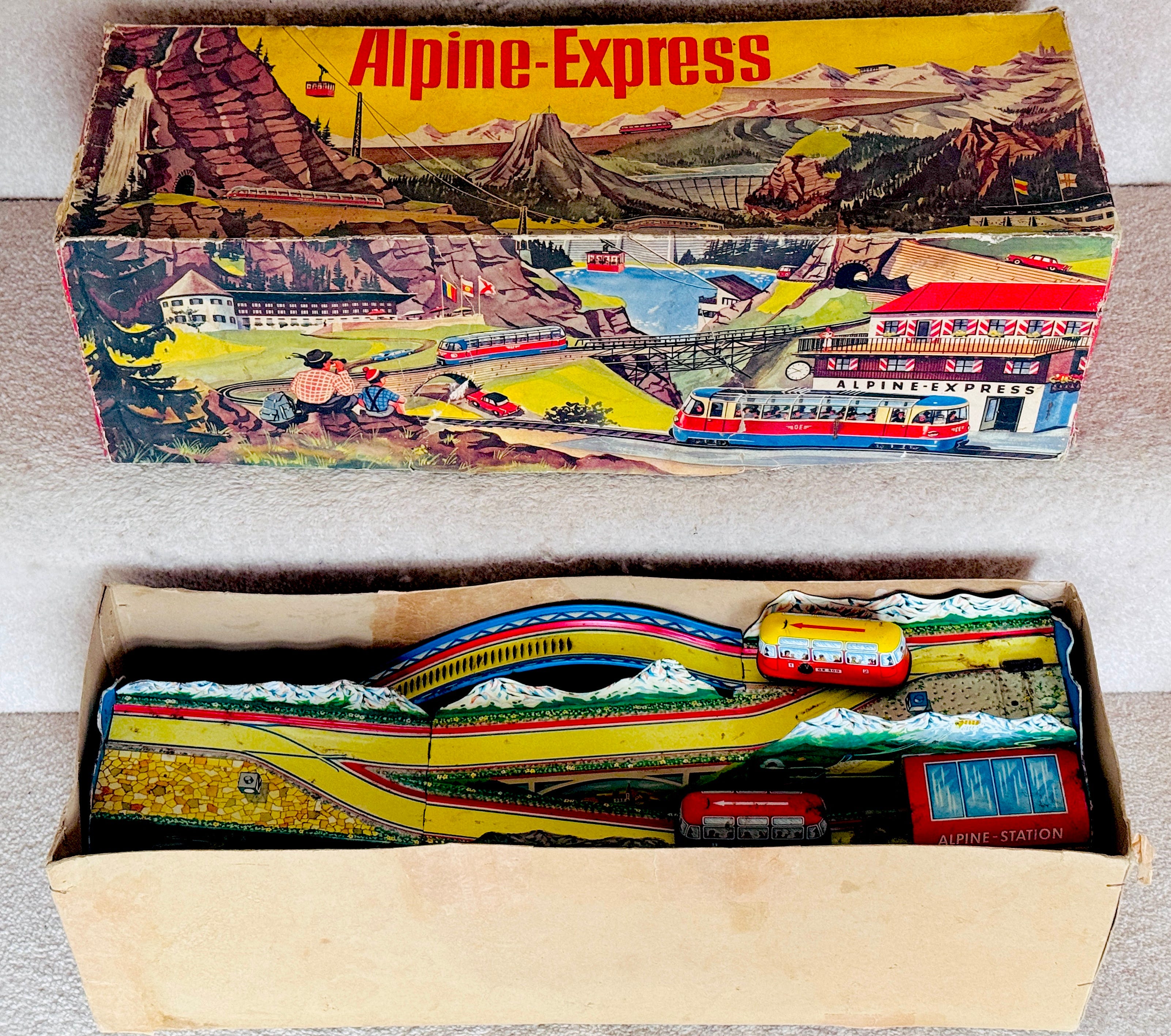
I got the most beautiful present for my birthday, something I wanted for decades. Tania found it on eBay, where complete sets occasionally surface. Over the years I had tried to describe it without showing a picture, and it’s hard: a painted, tabletop, stamped-metal, miniature mountain landscape with one-carriage wind-up trains running in it. If six or seven decades ago you didn’t see one and want it badly, those words will mean nothing. If, like me, you were fascinated by that genus of toys, you will immediately perk up. I simply could not believe it when I opened the package. People always talk about the power of smell to transport you back in time, but have they tried old playthings?
Technofix was a German outfit making a broad range of what are known as lithographed tin toys. They lasted into the 1960s until plastic took over. Apparently collectors in the US are especially fond of them. When I was six, my father bought me a small, glacial landscape with a flat, sky-blue lake in the middle and a single railway car, all now long lost. The car went gleefully round the crests of the mountains, meshing a gear with a serrated track on the way up, then sliding down slopes with a metallic noise like a marble rolling in a metal bowl. A circuit took less than ten seconds, and it went round and round until the mainspring in the little car gave out.
Why is this so wonderful? First, like all miniature landscapes, it casts you as a god overlooking the thing from a distance. That distance is nothing to you, because your hand can reach the car stuck in a corner, wind it up and restart the whole thing. This feeling of omnipotent flying happens in the model villages you find all over Europe as well, except there you are walking the streets between tiny houses and are technically a giant, not a deity. Model railways are better, but being to scale, they typically depict a banal, busy corner of the Alps, the kind you see out of your train window before the whistle blows and you enter the next tunnel. The stamped landscape instead sets the proper scene for godly powers: an entire valley at your disposal.
Second, the fact that the tin relief is first painted on and then stamped into shape gives it the attributes of both 2- and a 3-dimensional objects. It reads like a map and feels like a thing, and serves as some sort of explanation of how the Swiss Alps—because this must be Switzerland—came to be: first drawn flat and then pulled up, which of course mirrors what school taught you about geology. The dolomites, full of marine fossils, were once at the bottom of the ocean and crumpled up later. (Only a pedant would counter that there were no narrow-gauge railways in the Triassic.)
Third, this intermediate dimension, say 2.5D, inhabited by lithographed tin toys has quirky effects that one never gets used to. The people in cars and railway carriages are visible through the windshield face-on and from the side in profile. The interior of the car does not exist, only its projections, which we accept as truthful. This extends to details, because the stamping has a minimum radius. Much of the 3D is rendered by shading instead of volume, as if delegated down one dimension. This is trompe-l’oeil of a higher order, unique to these toys and the process that made them.
Something strange happened to me when I opened the gift and saw what was inside. I was a little boy again, and Tania saw my face go back all those years in wonder. I felt it myself and knew I had not looked like that since I was eight at a circus in Italy and someone put a lion cub in my lap: pure joy.
I am not the first to declare this heavenly writing, especially the last sentence.
How wondrous! Tania did a beautiful thing for you. I'm so glad you had that experience. There is nothing else like it.