
By the Kaaba
Leçons de Ténèbres
Over the years Areej le Doré, aka Russian Adam, has generously sent me several beautifully packaged bottles containing dark brown liquids, always accompanied by descriptions of materials all rather like these for his latest: “rare rose otto from Afghanistan, an exclusive, wild Malaysian blue agarwood oil, a unique, silky smooth oud hailing from Sri Lanka, or [sic] legally obtained, macerated deer musk grains from Siberia.” These descriptions give me the thrill of shopping in a souk somewhere along the Silk Road two hundred years ago, lulled by the magic of faraway places and never-to-be-repeated finds of fragrant oils.
The fragrances themselves, I must confess, have never fully done for me what I expect a fragrance to do: create a tune, a shape in the air, or tell a story with a beginning, a middle and an end. They remind me of the hoary joke about modernist atonal classical music in concert, when a child asks, “Are they still tuning up?” In Areej le Doré’s case, the piece would be written for bass flute, contrabassoons, double basses and kettle drums. There is unquestionably somber power and rich texture in there, but the overall light level is low and the shapes indistinct, like a collection of Rothkos in a dim room intended to preserve the acrylic paint.
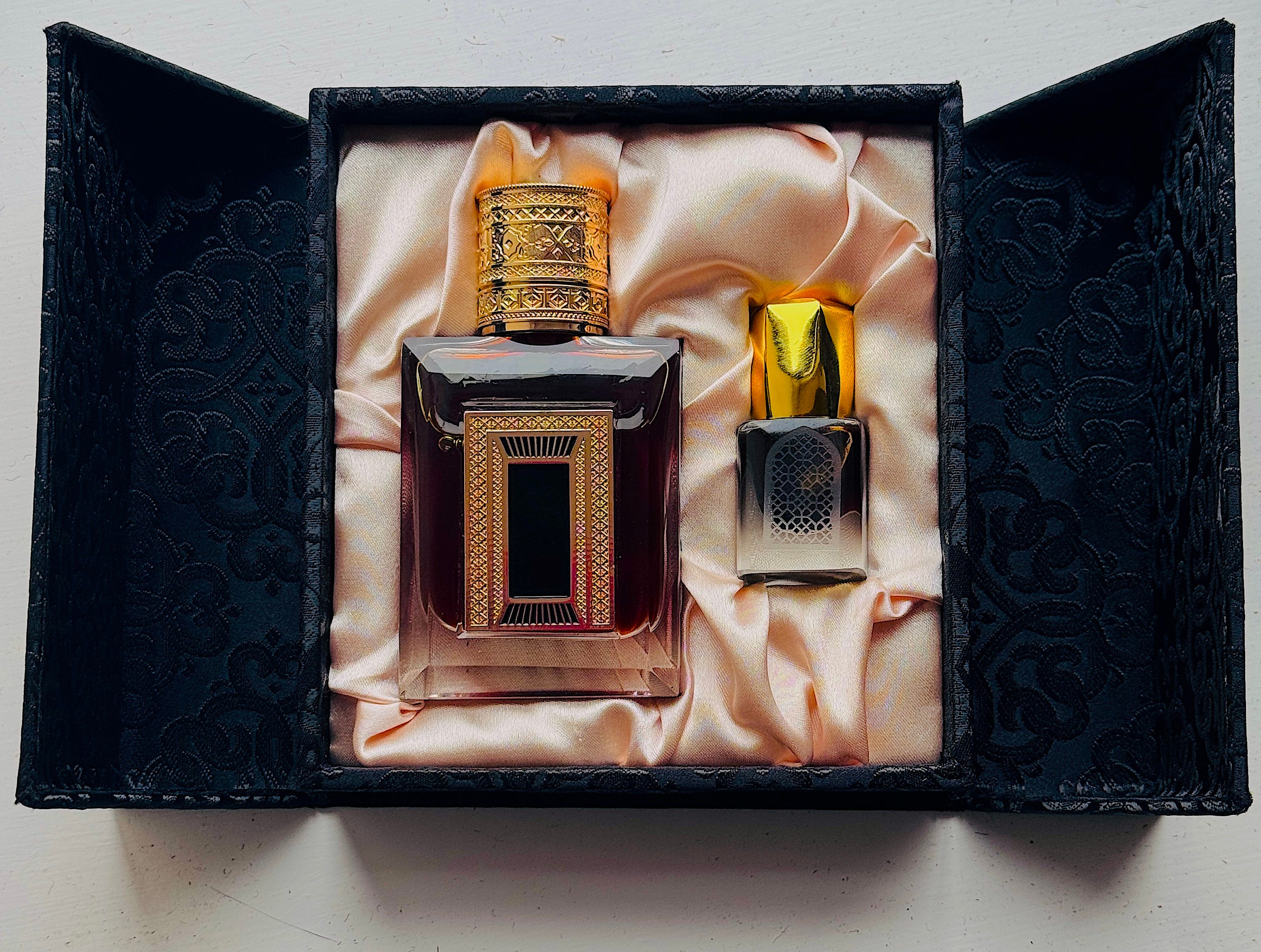
By the Kaaba will be released on December 20. He explains in a video the connection between perfume and the Kaaba, a magnificent black and gold cubical building in Mecca and focal point of pilgrimage. The packaging is spectacular: two bottles, one big (extrait) and one small (attar), on a satin pillow inside a black and gold fabric-covered box with a spring-loaded pair of panels that open symmetrically. The fragrance is as described, a vast incense-oud accord, with what smells to my nose like a touch of helional in the mix. It smelled great, but the basso profondo voice said nothing to me.
Then I had a sacrilegious idea. BTK suddenly struck me as an exemplary drydown base, something akin to Ambrarôme but less overtly animalic. I decided to try layering it, something I always discourage. Layering with full-span fragrances typically achieves the effect made famous by Charles Ives of two marching bands playing in different keys in the same parade. I decided to go for the most toppy fragrance on my shelf, the St Johns Bay Rum, all surface and little depth. The effect was stunning. For a start, the Bay Rum lasted twice as long, due to the fixative effect of whatever high-molecular-weight materials are in BTK. But it also smelled completely different, as amid the clove and bay a rose appeared, which I had not really noticed before.
Still in the same vein, I tried layering it with Eau de Guerlain, another jaunty, fresh thing with a tinkling citrus melody. As ever, it was Tania across the room who spotted the effect as I was still struggling to describe it: “What’s that Magnolan thing you’ve just sprayed?” Magnolan is a Symrise material discovered in the mid-1960s which became famous as the creamy-floral note in Ivoire (1979). Jean-Paul Guerlain had clearly cottoned on to it in 1974 and cleverly hidden it in citrus rather than white flowers. I had never noticed it in Eau de Guerlain before. I plan to play some more with other fragrances.
On past form, BTK will not be cheap, and some may question the wisdom of my suggestion to use it for layering. All I can say is that it is likely to do wonders for a lot of modern fragrances with skeletal drydowns. In fragrance as in music, bass is essential and mysteriously satisfying. Think of BTK as a perfume subwoofer, not cheap but in my experience hugely effective.
Perfume sub-woofer! I snorted my coffee! LOL
Such a respectful, sympathetic and clarifying review. Thank you.