

Engines
votive objects
I remember once driving out of Payson, AZ, heading north towards Flagstaff, and stopping at a four-acre lot of scrapped motorcycles, so many of them, leaning against one another densely in square groups, with narrow paths between. I walked around the beds of this metallic garden for an hour in a nostalgic trance. Every single motorcycle I ever lusted after was there, abandoned, sprawled in the company of others as in a mass grave. The dry desert air preserves them perfectly, like dead bishops in catacombs. There is very little rust and decay, though the alloy acquires an abrasive, salt-like patina unpleasant to the touch. In the Southwestern light the colors looked like enamel, one fuel tank after another in beautiful red and gold cloisonné.
I could trace the changing mindsets of the makers and their customers through the ‘sixties. Mr. Honda and his tiny early engines with practically no cooling fins, built to watchmaker’s tolerances, mated to austere black, pressed-steel frames, gradually giving way to larger engines and gaudier colors as his clientele became more affluent and American. The Yamaha logo proudly displaying its three tuning forks, as if to remind everyone that pianos, flutes and guitars were its main business, motorcycles just another loud noise. Suzuki and Kawasaki coarser and trashier, wedded to smoky two strokes long after they had begun to go out of style. In a corner, a lone Aermacchi from the days when Harley-Davidson owned it. The French call the record of events embodied in commemorative coins and medals histoire métallique. I knew this particular metallic history in my bones, and would gladly have bought it all, moved as I was to tears by this procession.
Now the internal combustion engine is near-extinct as a land species and will endure only in the air, a flying dinosaur, for the foreseeable future. All it had going for it was the high energy-content of liquid fuels. When after a century of waiting, batteries switched from heavy lead to light lithium, the extinction was brutal. Soon little children will no longer go vroom-vroom when pushing little cars around. The entire story of the engine was a heroic struggle to muffle the internal bangs that made it move, to increase their number to hundreds per second, and to quiet the vibrations of the moving masses. Each engineering choice endowed the machine with a bit of soul, a different look and a distinctive noise. Engines were species. Stop at a traffic light next to a Ducati and listen to the awkward, loping beat of its L-shaped engine. I feel sure its inventor Fabio Taglioni was tall, rangy and blunt. “Real men” used to accuse Japanese engineering marvels of sounding like sewing machines. The domestication of the four-stroke was, in retrospect, suicidally aimed at making it more like an electric motor.
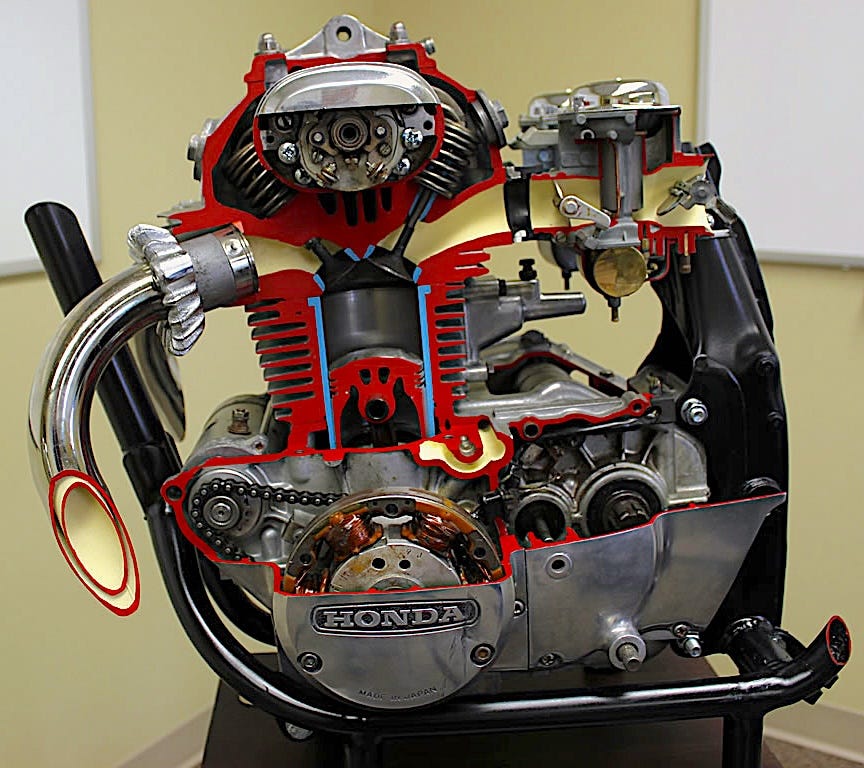
Where do engines go when they die? Some go to mass graves like the lot in Payson and slowly crumble to aluminum dust in the dry air. Some carry on in servitude as those special motorcycles coursing around the wall of death in a traveling circus. Shrunken, nameless, faceless, they are no longer proud machines and take third place to humans and trained animals. Children notice them, try to meet their blank stare and feel sad, but no one else does. Or they can end up in the lay places of worship we call museums. They are often exhibited cut open, with the edges of the wounds red to impress upon us that their maimed innards can never turn again, martyred mechanical saints, midway between an anatomical model and a mannerist crime scene. Memento motoris.
What a surprisingly moving requiem, Luca! I could almost hear the sounds of each engine. I relished the 2 days per week of school runs that our neighbor did on his motorcycles— a 1972 Indian and a Kawasaki. He loved his bikes probably more than his kids.
Thank you. This made me even more excited to pick up my Moto Guzzi V7 from winter storage in a few weeks