
Tino's Watch
Enicar Sherpa Star
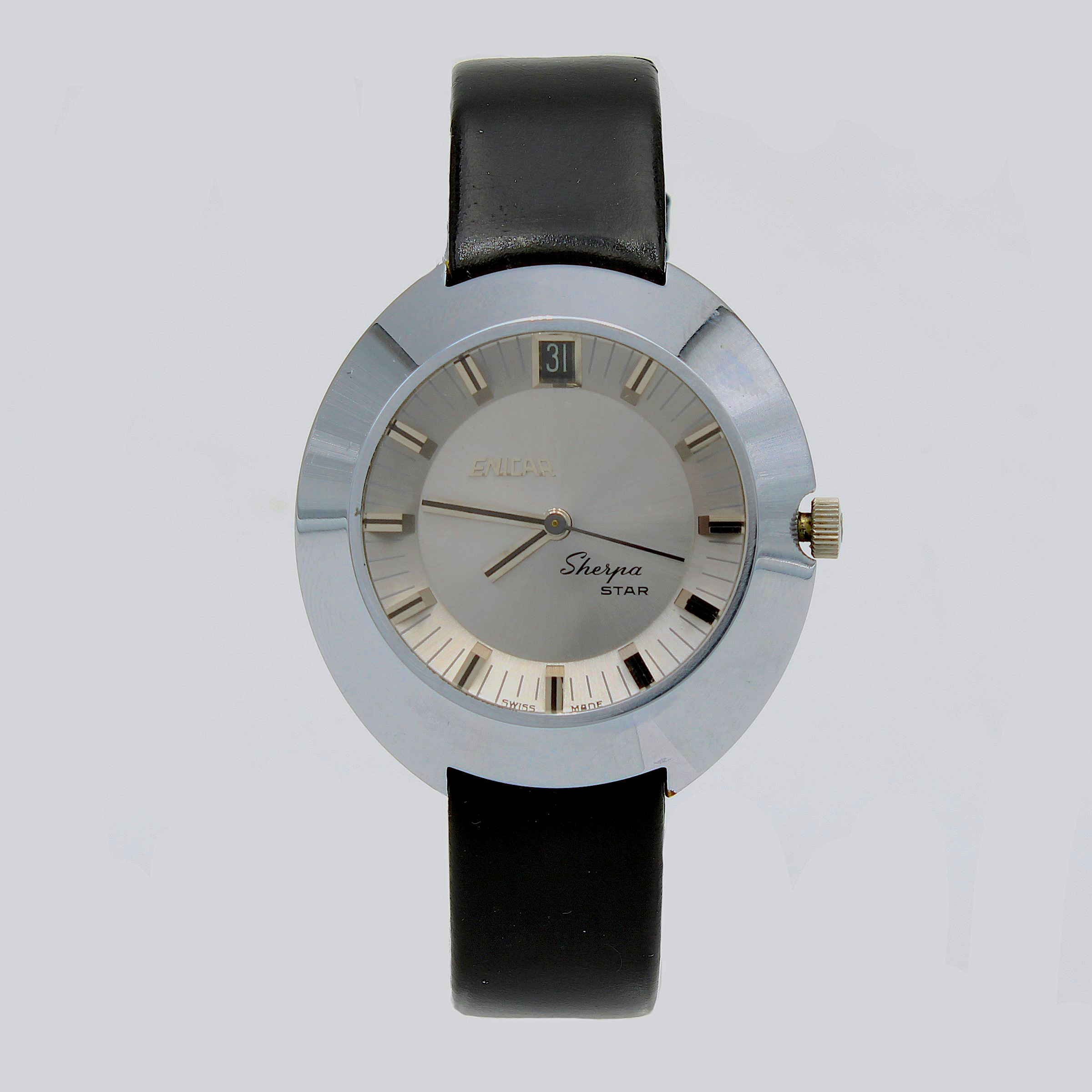
One day early in 1969 while for some reason rummaging through the top drawer of the chest in my mother’s bedroom I found a stainless steel Sherpa Star with a black leather band. I had never seen anything like it and fell instantly in love. My understanding of watches at the time did not stretch further than my father’s never-explained respect for Longines and my stepfather’s rugged Eterna-Matic, which apparently contained a tiny ball race in place of a balance jewel. The Sherpa struck me—and still does—as an irresistibly beautiful and precious object from the future, deposited by time travel among my mother’s scarves and gewgaws.
I asked her why it was there, and she gave a muddled answer about her friend Tino leaving it there for safekeeping. Looking back, I strongly suspect Tino had taken it off his wrist in her bedroom and forgotten it. I begged to have it. Tino was consulted and gave his assent, so I had it on my wrist when I went off to Spain on holiday. There I watched the moon landing while listening to La Playa, which is why I remember this all happened in 1969.
Tino, nominally my mother’s colleague, played a huge role in our lives in those years. He was a buyer for Upim, the company my mother worked for as a textile designer. This was Italy’s largest store chain, and its buyers were assigned a category of goods to procure for the company at the best combination of price and quality. Tino was therefore a Man of Gifts, received and given. Buyers for a large chain were lavishly corrupted by suppliers, for whom an Upim order was a huge deal. Bribes, or stecche, as they were known, were the rule. A buyer who did not take any would have been shunned as a dried-up husk.
I have no idea how many stecche Tino accepted in cash, but those given in kind were often passed to us. There was nothing strange about him having an extra expensive watch. His catchment area for suppliers was Piedmont and Lombardy, and that meant cases of Barolo and truffles. On our dinner table sat a small basket of the kind used for bread buns in restaurants, in our case full of potato-sized white truffles, which we used to slice with a mandoline on practically everything. Tino was treated like royalty on factory visits. He once took me to the largest paper mill in Italy, where the CEO gave us a linear tour from tree trunk to paper roll.
My first memory of Tino is when he took me to the only soccer game I have ever attended, at San Siro stadium. It was Italy vs Russia, a friendly. As we approached the stadium, we stopped by a truck selling drinks and merch, where I asked him to buy me a Soviet flag to wave. As it turned out, I had the only red flag in the stadium. People around us, assuming I was Tino’s son, questioned what sort of education he was giving me, for me to grow into such a traitor. He remained unfazed and jolly throughout.
His superpowers were speed and fluidity. Everything happened fast and easy; he always knew where to get something, who to ask, how to go to the front of the line. Superlative driving was where he expressed himself. He always went too fast, but with the ease and confidence that the gods smile upon. One weekend, I heard a car horn in the street below our flat sounding the first seven notes of Malcolm Arnold’s Colonel Bogey. One of his suppliers had let him borrow their Ferrari 250 Berlinetta (silver, red leather). He motioned me down, sat me in the passenger seat, and put a banknote on the glare shield. He said, “When the light goes green, if you can grab it before I hit fourth gear, it’s yours.” I could not reach it in time. We then went to the autostrada to, in his words, “Slap 220 across the face.1”
One Christmas he went to pick up my then-girlfriend at Milano Centrale to bring her to the ski resort where we were staying. He made it back in record time despite heavy snow, arriving half impressed, half miffed. He had found her irresistible so had put on a terrific show of fast driving, but midway was appalled to find that she had fallen asleep just as the road became icy and windy. She confessed to me that her so-called sleep was actually more of a narcoleptic, fear-induced faint. Nevertheless, I could sense her overall approval. To this day, I still think Tino is what a man should be.
“Schiaffeggiare il dueventi,” meaning 220 km/hr.
My father was a buyer for Upim too in the 60s! I remember the "gifts" arriving at Christmas comprising a Persian rug, champagne bottles in wooden boxes, silver cutlery, huge food hampers and the white truffles (which were put in a jar with rice and kept in the terrace hoping they will not spoil). Then he moved to logistics for La Rinascente and the gifts stopped.
Did you know Enicar is Racine in reverse?